Robust simulations of excited-state dynamics must balance physical accuracy, computational scale, and the electronic representation selected by decoherence.
In brief:
-
Reliability depends jointly on the initial molecular ensemble, the electronic-structure method, and the dynamics algorithm.
-
Scalability should be judged by the time required to obtain converged observables, not simply by the cost of one trajectory step.
-
In aggregates and other systems with dense excited-state manifolds, the physically relevant electronic states may be localized rather than adiabatic energy eigenstates.
Mixed quantum–classical dynamics (MQCD) lies between fully quantum nuclear–electronic dynamics and conventional molecular dynamics, in which nuclei move classically on a single potential-energy surface. In MQCD, the nuclei follow classical trajectories, while transitions between electronic states are treated quantum mechanically. This compromise underlies widely used methods such as surface hopping, Ehrenfest dynamics, and multiple spawning.
For small molecules and short timescales, these methods have produced a substantial body of useful results. The next generation of applications is more demanding. Researchers now want to simulate nanoscopic systems, active environments, long-time charge and energy transport, and repeated passages through regions of strong nonadiabatic coupling. In these regimes, approximations that were tolerable for a single ultrafast relaxation event may become controlling sources of error.
In this invited Perspective that Rafael S. Mattos and I wrote, we organize the challenges MQCD must face around three requirements: reliability, scalability, and representation.
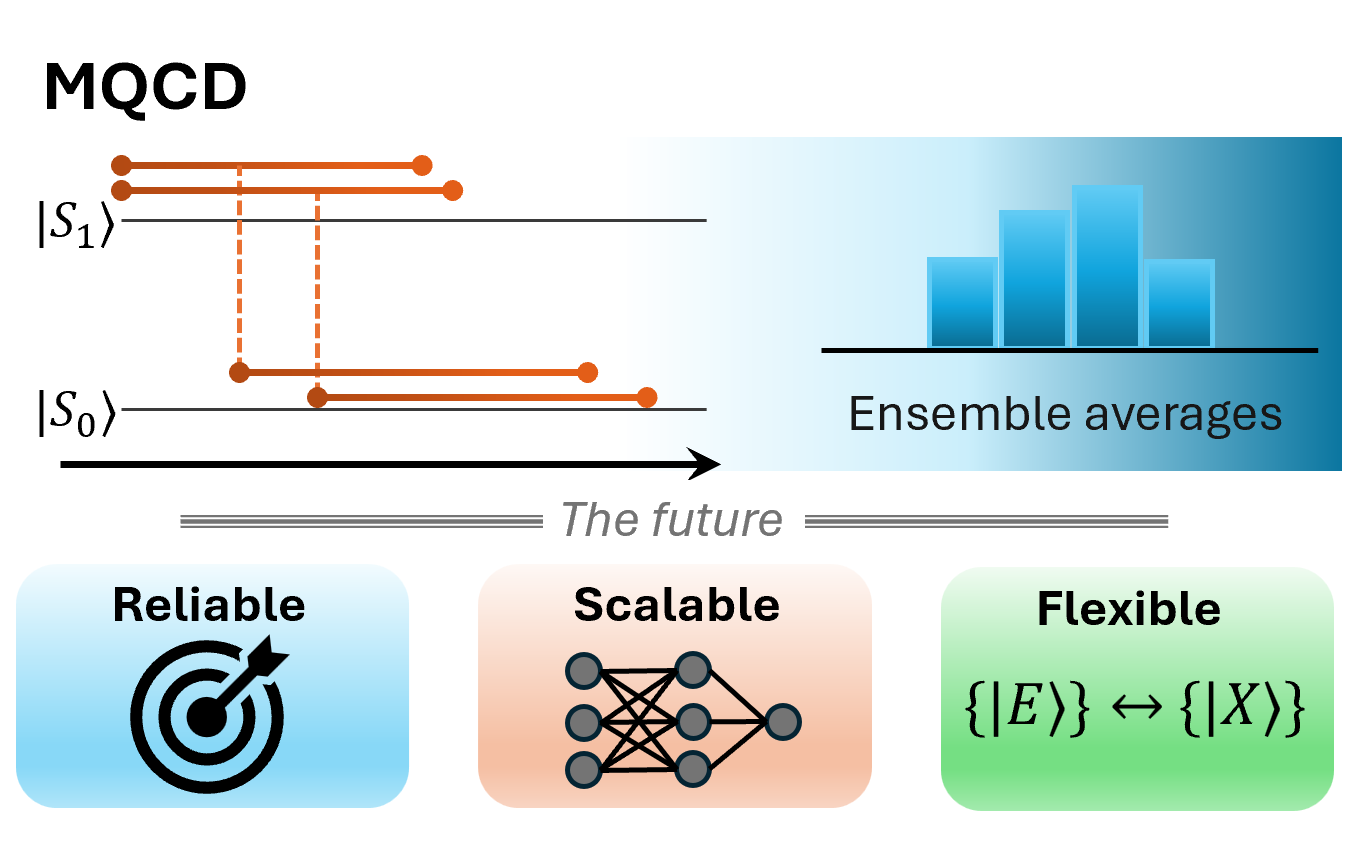
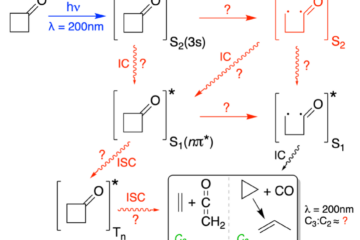
Reliability comes first. A dynamics calculation depends not only on the propagation algorithm, but also on the initial ensemble and on the electronic-structure method that provides the energies, gradients, and couplings. The cyclobutanone prediction challenge showed how strongly the outcome can depend on this choice. Single-reference methods dominated by dynamic correlation may work well for photophysical relaxation, but they can fail when bond breaking or strong multireference character becomes important. Methods dominated by static correlation face the opposite problem. Predictive dynamics therefore requires a balanced treatment of both static and dynamic correlation.
Controlled comparisons are essential. Fixing the initial ensemble and electronic structure isolates the dynamics algorithm; fixing the algorithm while changing the electronic structure probes the underlying energy landscape.
The second requirement is scalability. On-the-fly simulations repeatedly call expensive quantum-chemistry programs, often without reusing information generated by other trajectories. Machine-learning potentials, analytical models, and excited-state force fields can reduce this burden. Their benefit, however, is an amortization effect. Building a reliable surrogate requires reference calculations, active learning, and uncertainty assessment. It becomes worthwhile only when this initial investment is spread over sufficiently many trajectories or long cumulative simulation times. The relevant quantity is therefore the time to converged observables, which combines the cost of each evaluation with the rate at which statistical and model uncertainties decrease.
The third requirement, pointer basis flexibility, is less commonly discussed. Most MQCD simulations interpret and report their electronic populations in the adiabatic energy basis. For isolated molecules with well-separated electronic states, this is often reasonable. In molecular aggregates and crystals, however, environmental fluctuations may stabilize localized electronic or excitonic states. Decoherence then selects a different pointer basis—the representation in which quantum superpositions decay into robust alternatives. Populations defined in the wrong basis may become artifacts of the algorithm rather than physically meaningful observables.
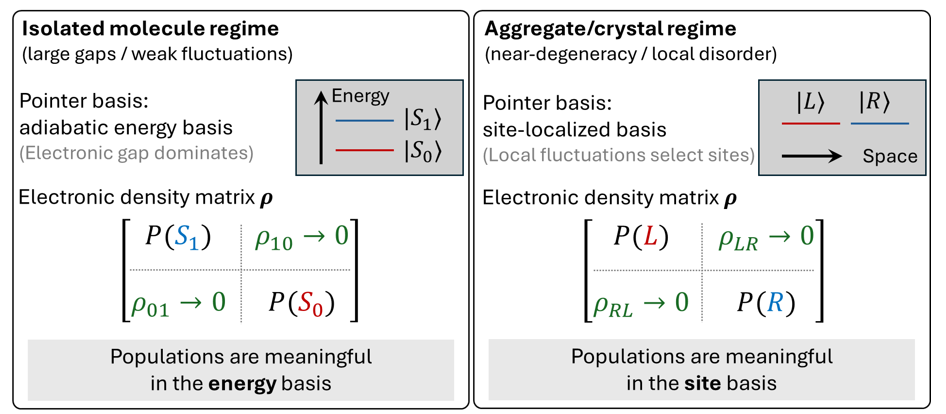
We do not propose a single replacement for current methods. Instead, we argue that future developments should combine controlled benchmarking, uncertainty-aware surrogate models, and greater flexibility in electronic representation. Open-quantum-system approaches, including Lindblad dynamics and stochastic unraveling, offer one possible route while preserving the trajectory-based workflow that makes mixed quantum–classical dynamics practical.
MB
Reference
[1] R. S. Mattos, M. Barbatti, Mixed Quantum–Classical Dynamics for Molecular Excited States: Reliability, Scalability, and Representation, WIREs: Comp. Mol. Sci. 16, e70079 (2026). 10.1002/wcms.70079