Discovering the photophysics of resveratrol opens up its use in pharmaceutical innovations.
In brief:
- The explore-then-assess strategy is introduced to map resveratrol’s internal conversion pathways, revealing critical molecular behaviors.
- A primary pathway involves photoisomerization via a twisted-pyramidalized conical intersection, leading to trans or cis isomers.
- A secondary pathway forms a closed-ring derivative, potentially linked to reactive oxygen species and photodynamic therapy applications.
Resveratrol, a polyphenolic compound found in red wine, grapes, and various plants, has garnered significant attention for its broad spectrum of health benefits, including its antioxidant, anti-aging, and anti-carcinogenic properties. Its ability to modulate cellular processes and combat oxidative stress has positioned resveratrol as a promising candidate for pharmaceutical applications. However, to harness its full potential, a deeper understanding of its photophysical behavior is essential. The interactions between light and resveratrol molecules, particularly how they dissipate energy through internal conversion pathways, hold the key to unlocking new therapeutic strategies.
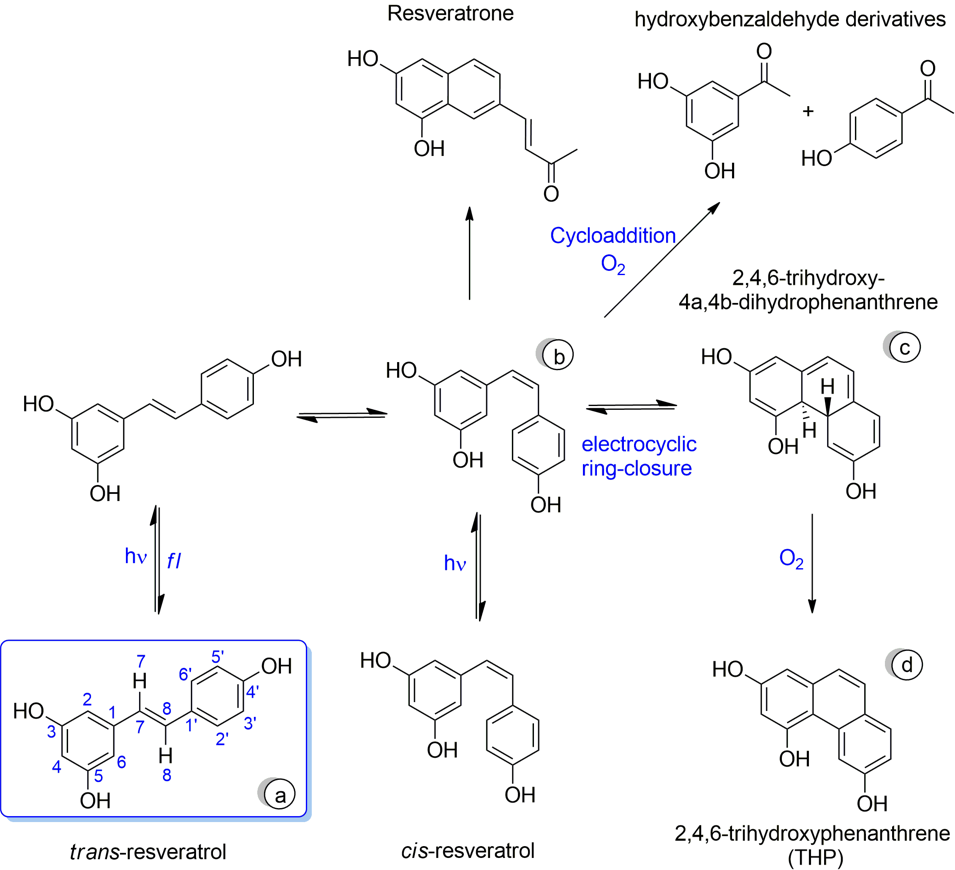
In our recent work—led by Mariana Yoshinaga from Willian Rocha’s group at the Federal University of Minas Gerais—we mapped out the internal conversion pathways of trans-resveratrol using an innovative computational approach called the “explore-then-assess” strategy. This strategy represents a significant step forward in computational photophysics by combining the extensive exploration of molecular configurations with rigorous theoretical assessments. By doing so, we can gain a comprehensive understanding of the molecular dynamics at play and identify pathways that are most relevant to pharmaceutical developments.
The explore phase of our strategy involves probing the entire multidimensional configurational space of the molecule, in this case, trans-resveratrol, using nonadiabatic dynamics simulations with an inexpensive semiempirical method. This allows us to capture the complexity of the molecule’s excited-state behavior. To achieve this, we employed ODM2/MRCI, which provides a qualitative yet sufficiently detailed picture of the potential energy surfaces. Through this exploration, we identified five distinct conical intersections where internal conversion—the process by which the molecule returns to its ground state—could potentially occur. These intersections are critical junctures in the photophysical pathway, as they dictate the molecule’s photochemical fate.
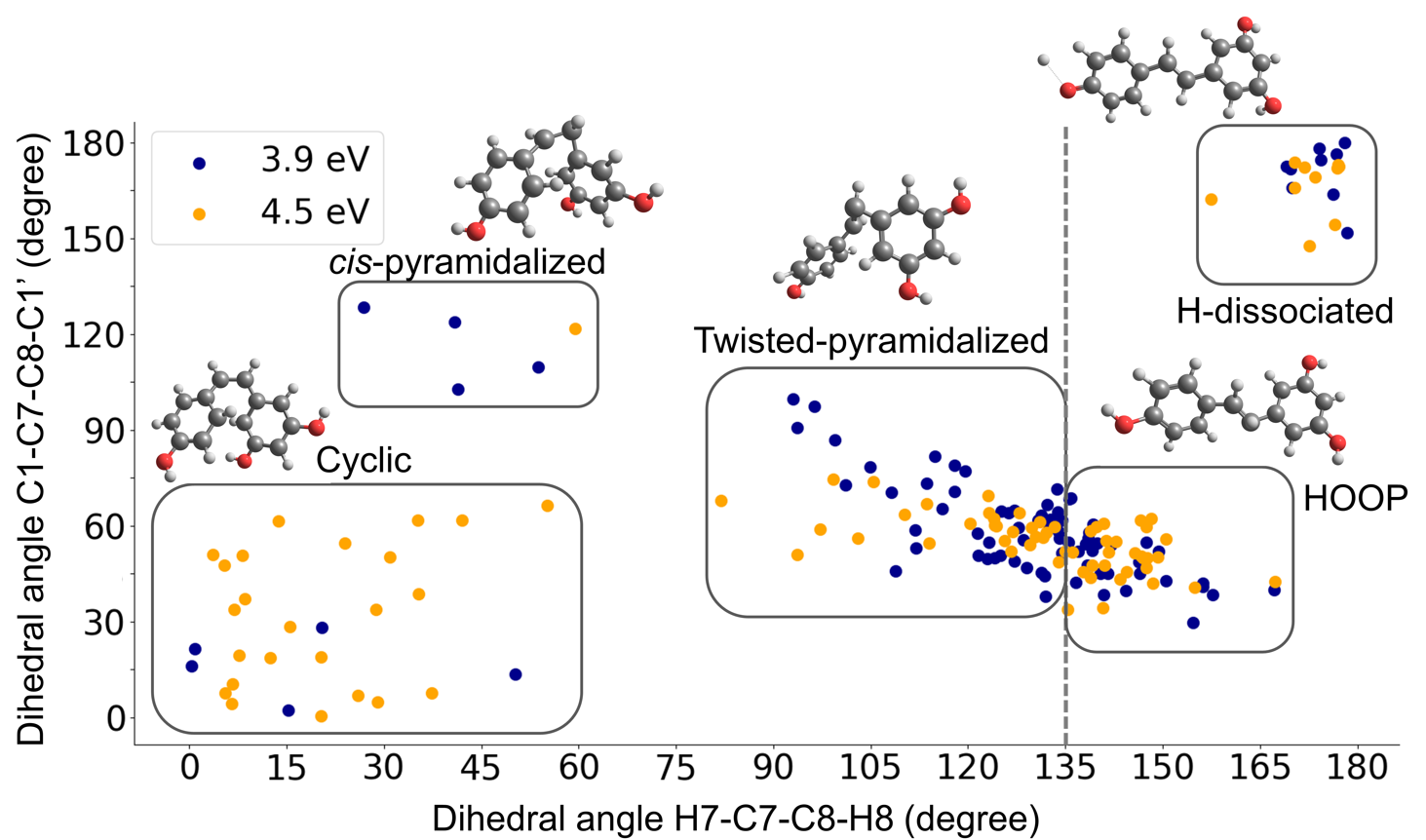
The subsequent assess phase is where we narrow our focus to the most promising pathways identified during the exploration. Here, we apply CASPT2, a high-level ab initio theoretical method, to evaluate the feasibility and relevance of these pathways in the gas phase. Our analysis revealed that the primary photoisomerization pathway of trans-resveratrol involves a twisted-pyramidalized S1/S0 conical intersection. This pathway is significant because it leads to the formation of either trans or cis isomers, depending on the specific molecular dynamics at play.
Interestingly, our study also uncovered a secondary pathway where cis-trans isomerization occurs while the molecule is still in its excited state, followed by internal conversion at a cyclic conical intersection. This process results in the formation of a closed-ring resveratrol derivative. In principle, such an isomer is expected only to be formed from the cis, not trans-resveratrol.
The presence of the cyclic derivative is particularly intriguing because it may be linked to the production of reactive oxygen species, which have been previously reported in related studies. Such species are central to the mechanism of photodynamic therapy, where they induce localized cell death, making this pathway potentially valuable for developing new cancer treatments.
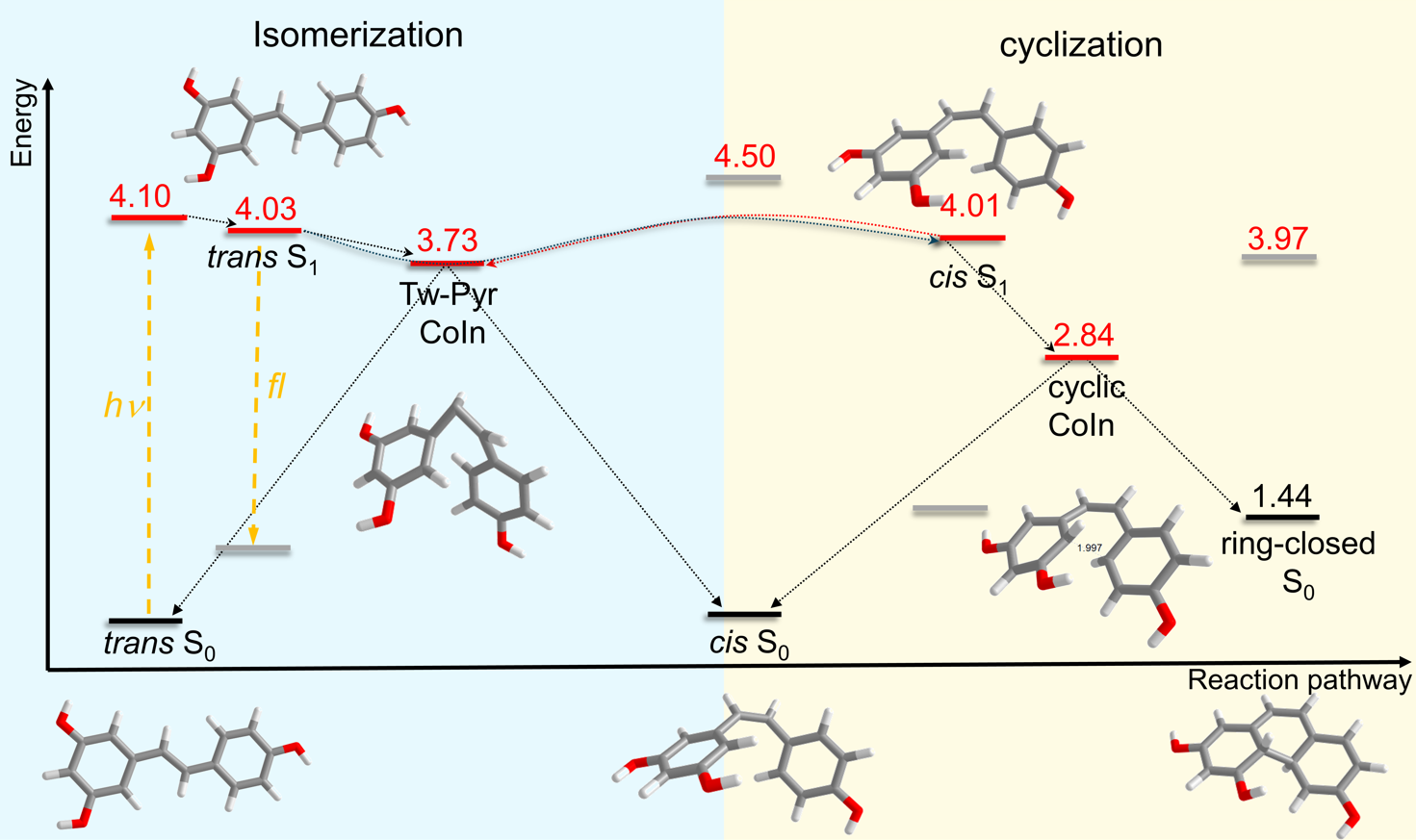
In conclusion, by applying the explore-then-assess strategy to study the photophysics of resveratrol, we have not only enhanced our understanding of its molecular dynamics but also identified novel pathways with potential pharmaceutical applications. This approach underscores the importance of combining broad exploratory simulations with targeted theoretical assessments to uncover the complex behaviors of bioactive molecules, paving the way for future innovations in drug design and therapy.
MB
Reference
[1] M. Yoshinaga, J. M. Toldo, W. R. Rocha, M. Barbatti, Photoisomerization Pathways of trans-Resveratrol, Phys. Chem. Chem. Phys. (2024). 10.1039/D4CP02373K