A new twist on Ehrenfest dynamics brings a principled description of decoherence into mixed quantum-classical simulations.
In brief:
-
Builds a decoherence-corrected Ehrenfest scheme (SLED) directly from the Gisin-Percival quantum-state diffusion equation, ensuring Lindblad-type, physically consistent dynamics.
-
Reproduces both populations and coherences for standard test models (Tully models and spin-boson Hamiltonians), often outperforming common ad hoc corrections.
-
Implemented in the new Skitten program and designed to become a bridge between trajectory-based dynamics and open quantum system theory.
We revisited one of the oldest mixed quantum-classical workhorses: Ehrenfest dynamics. The goal was simple to state and annoying to achieve—keep the efficiency of classical nuclear trajectories, but give decoherence a treatment that is not bolted on by hand.
Mixed quantum-classical dynamics is used when fully quantum simulations are too expensive. Electrons are treated quantum-mechanically, nuclei as classical particles, and the two interact through coupling terms. Ehrenfest dynamics is the mean-field version: nuclei feel an average potential from all populated electronic states. It’s clean and elegant, but it has a well-known flaw: coherence never really dies. Once different electronic states are occupied, the method tends to keep artificial superpositions long after a real molecule would have decohered through interaction with nuclear motion.
Most popular decoherence fixes tape extra terms onto the equations or periodically damp the electronic coefficients. They often work, but they are ad hoc and can violate basic quantum requirements such as linearity or complete positivity of the density matrix. In this work, we tried the opposite: starting from a solid open-quantum-system equation, we built a trajectory method from it.
The key ingredient is the Gisin-Percival quantum-state diffusion (QSD) equation, a stochastic Schrödinger equation whose ensemble average reproduces a Lindblad master equation. In QSD, the wavefunction performs a noisy evolution that tends to localize on eigenstates of a chosen pointer operator—here the electronic Hamiltonian in the adiabatic basis. The randomness is tuned by a parameter κ that encodes the strength of electron-nuclear coupling.
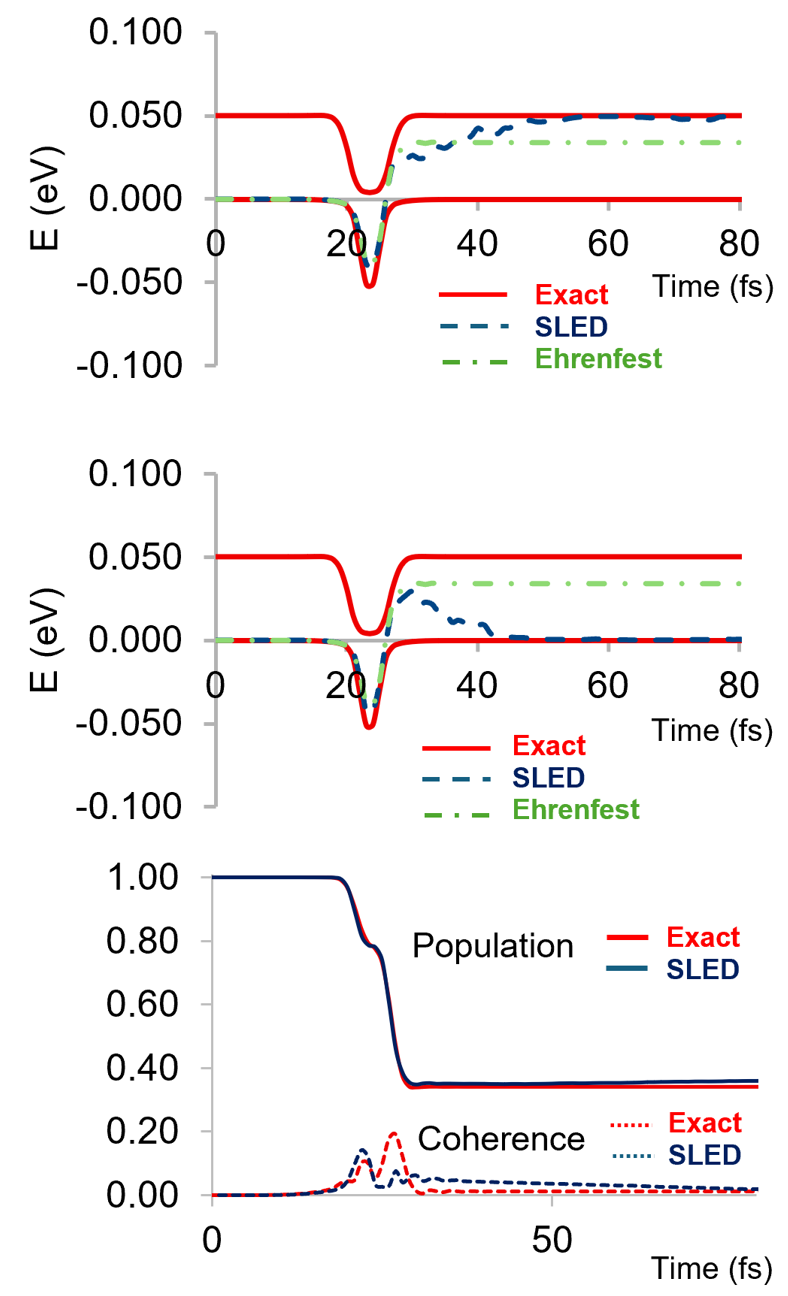
SLED naturally adds decoherence to Ehrenfest dynamics.
Plugging QSD into the Ehrenfest framework gives SLED: Ehrenfest Dynamics with Spontaneous Localization. Each trajectory now carries a stochastic electronic state that can collapse towards a single adiabatic surface, while the ensemble of trajectories reproduces a Lindblad-type evolution of the electronic density matrix. The method preserves linearity, trace, and complete positivity at the ensemble level, which is rarely guaranteed in mixed quantum-classical schemes.
We tested SLED on the usual suspects: Tully’s 1D model crossings and multidimensional spin-boson Hamiltonians. In many cases, SLED reproduces electronic populations and the decay of coherence on par with quantum wave-packet calculations, and it succeeds precisely where standard surface-hopping with simplified decay of mixing fails (for example, for the notorious Tully 2 transmission curve). For higher-dimensional spin-boson models, SLED matches populations from MCTDH and gives a reasonable picture of coherence, including its initial decay.
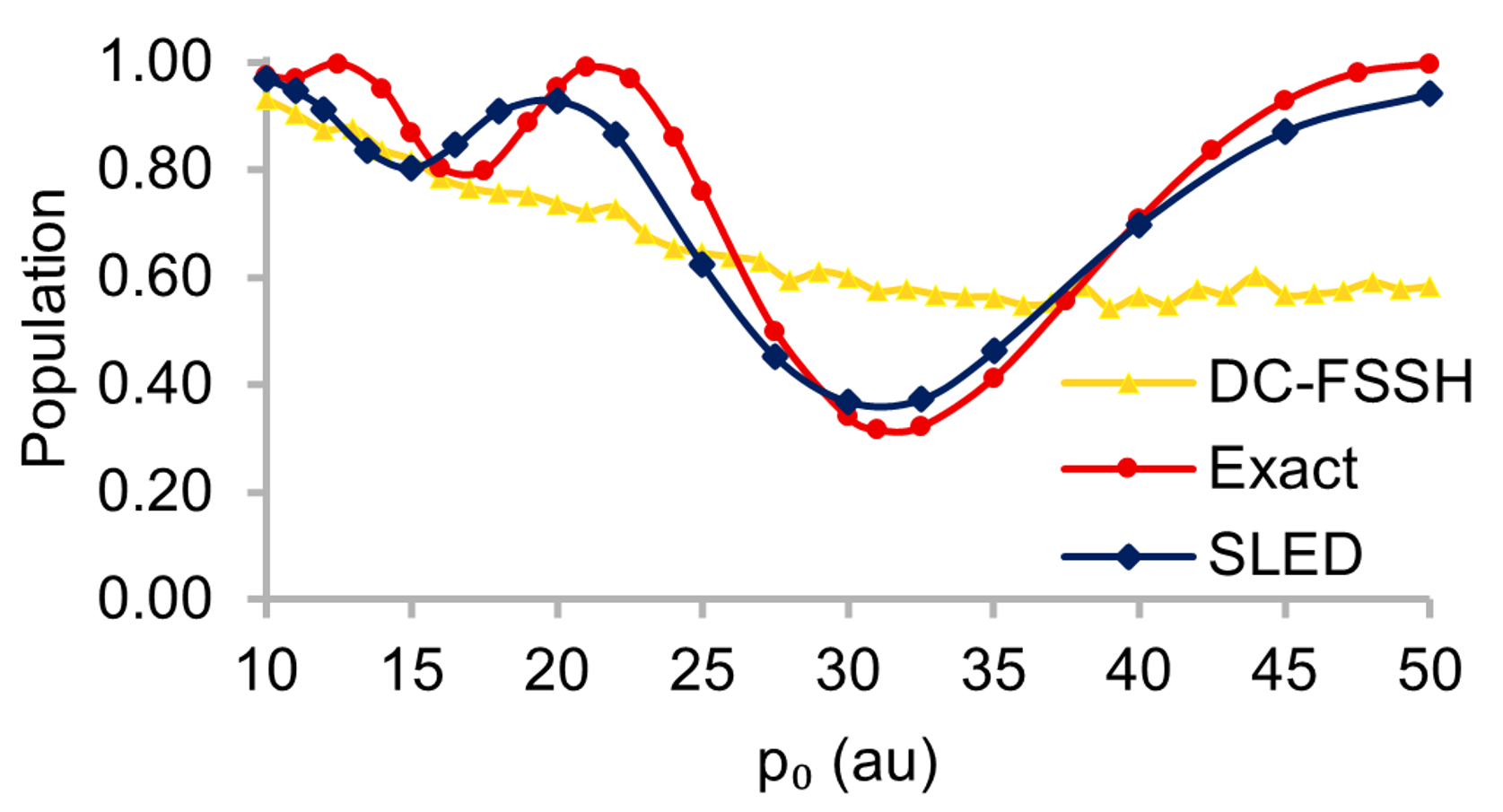
Tully 2 transmission as a function of the initial momentum.
The story is not finished. So far, κ has been treated as an adjustable constant, and the paper clearly shows that this is too crude: different momentum regimes and different parts of phase space would require different effective decoherence strengths. The discussion section outlines how κ should ultimately become a time- and phase-space-dependent kernel κ(t; R, P), still compatible with a Lindblad-like, completely positive evolution.
SLED is implemented in the new Skitten code and is planned to be integrated into Newton-X, making it accessible for realistic molecular simulations. For now, it should be seen as a proof of concept: a way to show that we can keep independent trajectories and still base decoherence on a proper open-system framework, rather than on clever but fragile patches.
MB
Reference
[1] A. A. Tomaz, R. S. Mattos, S. Mukherjee, M. Barbatti, Ehrenfest Dynamics with Spontaneous Localization, J. Chem. Phys. 163, 214114 (2025). 10.1063/5.0297596