Active learning turns costly surface-hopping into a push-button workflow.
In brief:
-
Fully automated active learning loop for FSSH inside Newton-X with MLatom via sockets.
-
Validated on two extremes: ultrafast fulvene and long-lived pyrene fluorescence.
-
Longer, statistically converged ML dynamics can rival—and sometimes outclass—limited QM references.
In a project that’s the heart of Matheus de Oliveira Bispo PhD thesis, MELTS (“MELTS Efficiently Learns Trajectories and Surfaces”) is introduced as a fully automated active-learning engine for fewest-switches surface hopping (FSSH) dynamics. It plugs Newton-X (for dynamics) and MLatom (for machine-learning models) together through socket-based communication to avoid the heavy I/O and import overhead that typically slows ML-driven simulations. The result is a practical workflow: start MELTS, let it sample uncertain regions, retrain, and iterate. No hand-holding.
Why this matters. Nonadiabatic dynamics can demand millions of electronic-structure evaluations; that’s months to years of wall time. MELTS swaps those expensive calls for ML interatomic potentials trained on the fly. It estimates uncertainty by comparing independently trained model sets, sampling only when the model is unsure and stopping trajectories that wander into risky territory. This keeps the data focused where the physics happens: along the pathways that actually drive hops.
Two testbeds show the range.
Fulvene represents the quick-and-chaotic end (tens of femtoseconds). After ~53 active-learning iterations, MELTS’ ML ensemble reproduced state populations and key structural motions with confidence intervals overlapping high-level ab initio results, while cutting total compute by roughly an order of magnitude versus a conventional pure-QM workflow on the same task.
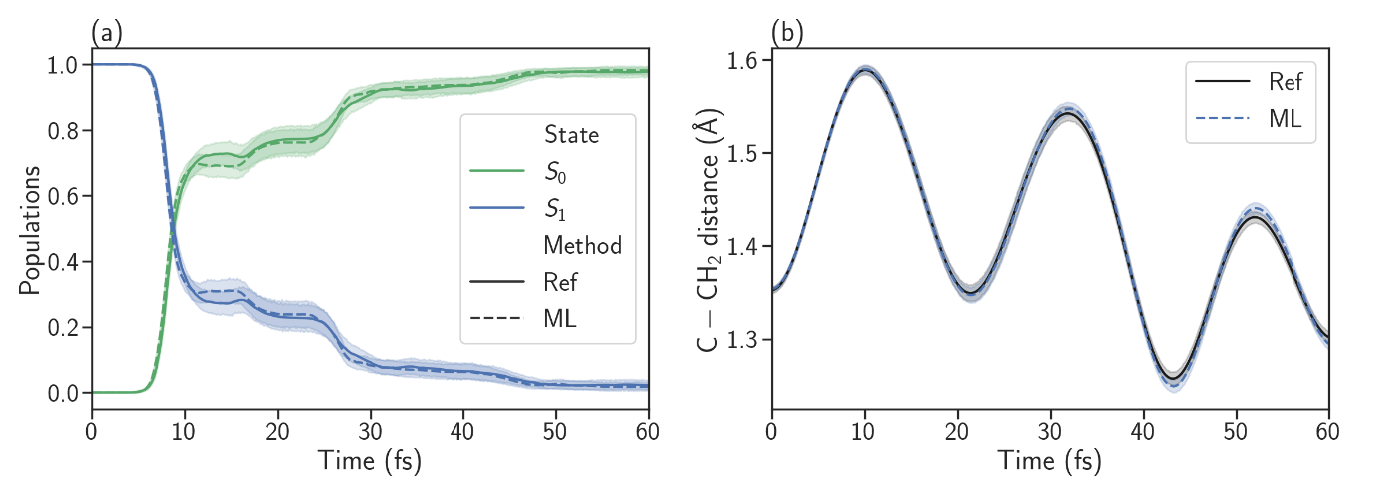
(a) Populations of ground and excited states and (b) C–CH2 bond length of fulvene as functions of time averaged over all trajectories propagated with ML and conventional QM methods.
Pyrene sits at the other extreme: non-Kasha fluorescence governed by a long-lived S1/S2 equilibrium. Here we used MELTS to accumulate ~1 ns of FSSH sampling (0.5-fs steps) and then computed the emission spectrum from 2000 emitters per state at the ADC(2)/def2-SV(P) level. The ML-driven spectrum is semiquantitatively accurate, yielding a fluorescence lifetime of 83 ns versus 87 ns from a prior QM study, while enabling vastly longer sampling (∼894 ps of relaxed cumulative time versus 22 ps previously). That extended sampling shrinks statistical uncertainty and even exposes where the limited-length QM reference should not be treated as ground truth.
Performance and practicality. With commodity workstations (single GPUs), the active-learning phases for fulvene and pyrene finished in about 1.7 days and 2.6 days, respectively. End-to-end, the pyrene study that would balloon into decades of compute under a naïve QM-only plan becomes a handful of days with MELTS. The code is available to the community and designed to be extended (e.g., improved UQ, oscillator strengths, spin–orbit couplings).
Caveats worth keeping in mind. The models still rely on the quality of the reference method used for labeling; TD-BA couplings and velocity-rescaling choices shape outcomes. But as a workflow—clear protocols, minimal intervention, and strong validation across time scales—MELTS looks like a step toward making long-time excited-state dynamics routine rather than heroic.
MB
Reference
[1] M. de Oliveira Bispo, R. Souza Mattos, M. Pinheiro Jr, B. C. Garain, P. O. Dral, M. Barbatti, MELTS: Fully Automated Active Learning for Fewest-Switches Surface Hopping Dynamics, J. Chem. Theory Comput. (2025). 10.1021/acs.jctc.5c01454